The Fictorian Era

Archive for August, 2011

Pesky Distractions and Writing Avoidance

29 August 2011 | 7 Comments » | clancy

I admitted today, to my fellow Fictorians, that I am avoiding writing.  This is the first step to recovery – I hope.  There are many reasons I am not writing or not feeling creative in the least.  The suspected top items probably include:  too many other obligations (writing-related and not), my work space is disorganized and a disaster of clutter, and my writing is still lacking and critiques tell me so.

 My plan.  I have a week before this post is due, so let’s do an experiment together.  I will try a variety of things to alleviate said problems and report if they are helping – on a daily basis.  I know you won’t see any of this until the week is up, but go along with me and we’ll see if it doesn’t help me and possibly you at some point in the future.

 Monday – Harsh critique has me depressed, but I have now admitted I have an avoidance problem happening, so this will be my attempt to correct the situation.  I want to take a nap, go to the movies or read a book. Obvious avoidance tactics…. And I succumbed.  I ended up taking a nap, watching a movie, reading and indulging in food therapy.  It was ugly.  But, I’m feeling less depressed.

 Tuesday – So far, still being distracted by other obligations, but I really do have to wrap up the minutes for my online board meeting.  So, working on that.  I’m second banana for my local Utah Romance Writers Conference coming up in October.  I got a lot done on the conference program and on the minutes, but no writing.  Still hopeful.

 Wednesday – Epic fail on the writing again.  More board meeting, more minutes, more program.  But, the minutes are done and the program is 75% done.  Had an evening field trip in relation to the upcoming conference, too.

 Thursday – Honestly, I don’t know what happened today. I did some reading.  Lots and lots and a painful amount of emails, as usual.  I had a powwow with my critique partner about the problem with my plot.  We came up with some thoughts.  Discussed going back to work on another story that I’m more clear on.  Ran some errands, did dishes and stuff.  Alas, no writing.

 Friday – My mom was off today, so we took advantage of her three-day weekend to plan a list of outside honey-do’s that we need to get done before summer disappears.  Something like thirty tasks, some small, some bigger.  Then we checked our storage room for supplies, shopped for the rest and started knocking out this list.  No writing.  Do I sound like a broken record?

 Saturday – More Honey-do list work with an afternoon break for a class and a meeting I had to go and then back to work on the list.  I am so tired.  I’m thinking maybe I need to just bully my way thru on the current writing whether it’s crap or not and just finish it.  I can fix it after.  At least I was thinking about it today. Sigh.

 Sunday – The Honey-do list got more than half crossed off.   Work around the homestead – 1 / Writing – 0.

Monday – My post is due today and it’s a new week.  Last week may have a been a bad week to try and fix this problem, but I did make some headway.  I got other tasks done that I needed to (writing, non, and around the house) and I feel more like stuff is off my plate so I can focus on writing.  I know I should be writing every day even if it is only for fifteen minutes or something.  Does my blog count?  No more excuses.  I will write no matter what!  Having thought about it all week and waffling on how to proceed, I give the current work two hours.  If I can’t write on it, I’m changing to a different story.  I still need to clean and organize my writing space.  I will dedicate one hour a day to getting it sorted out.  I have hope for this week.  Fingers crossed, ya’ll!
Writing to Music

26 August 2011 | 9 Comments » | Matt Jones

While surfing a few writing boards, one topic that I see appear quite often is the subject of music.  Usually it’s someone asking what music a writer listens to while writing, and how it affects them.  In other cases, I’ve seen people list a few bands and almost ask if it’s ok to listen to it while writing.  My answer has and always will be, if it helps you write, do it!

Neil Gaiman states pretty elegantly in the liner notes to his music cd “Where’s Neil when you need him:” “music was always part of the writing process — different music for different stories.”  Brandon Sanderson wrote in in his blog: “Music is a large part of the writing process for me. Listening to particular songs, with particular beats, can really get me into the writing mood, sparking images and ideas in my head. I depend on it in many cases to make me write when, sometimes, I don’t feel like it.”  Sanderson, when asked specifically what he listens to, he goes from classical, Metallica, Daft Punk, etc.

Personally, I listen to rock when I want a fast paced scene, and classical or Celtic when I want a softer feel.  I try to match the beat to the rhythm of the scene.  Look at the music you like and look at your scene.  Whichever genre or song you think best matches how you want to write, use it.  You don’t need permission, you just need to write!

Manuscript #5: Lessons Learnt

24 August 2011 | 11 Comments » | KylieQ

Having just closed the book, so to speak, on the first draft of my fifth novel, MUSE, it’s a good time to think about what I’ve learnt while writing this manuscript.

Lesson #1: What works for others, doesn’t necessarily work for me. I’ve previously mentioned I would love to be able to write from a detailed outline. I’ve tried it but can never stick to the plan. What does work for me is a very loose outline on index cards. It helps keep the story’s path clear in my mind while still allowing the flexibility to move, add or discard scenes as I need to.

Lesson #2: I need deadlines. Without them, I don’t write. I am fortunate to be a part of a wonderful goal-setting group. At the start of each week, we email around our goals and account for the previous week’s progress. I don’t like to admit I failed to achieve my goals so this often pushes me well past the stage where I would have otherwise stopped. And one day when I have to write to someone else’s deadlines, this practice in meeting goals will pay off.

Lesson #3:  I need to keep my mind in my story’s world. This means focusing my free time reading on relevant topics and not spending too much time in front of the tv. The story flows best if I can keep myself in my imaginary world. It starts to fall apart when I get distracted. This year’s season of Master Chef almost killed my story.

Lesson #4:  The this-is-crap stage. With every new manuscript, I wholeheartedly believe the first two thirds is the best thing I’ve ever written. Then I hit 70,000 words and the this-is-crap zone where doubt creeps in: This story is terrible. The plot is too contrived. I’m a lousy writer. What made me think I could write another book? The next 10,000 or so words are invariably painful, progress is slow and I spend weeks, or sometimes months, stalled here. This time, I knew what to expect and when the 70,000 word this-is-crap stage arrived, I pushed through, telling myself I had been here before and it would pass. And the knowledge that this was my this-is-crap stage did help, to an extent. It was still agonising and I wrote far slower than I had until then. But by recognising this as another stage of my creative process, I was able to move on.

Lesson #5:  It doesn’t matter if I can’t write the ending on the first draft. I usually finish just two or three scenes short of the end and it’s not until the first, or even second, re-write that the ending comes out. That’s okay. For me, the first draft is about learning the story and getting to know the characters. I need to sit on the ending, puzzle it through, spend some time getting to know the story again, and then that ending, previously so elusive, usually flows.

So now it’s time to put away MUSE and let it simmer in my subconscious for at least six months before I return to it with fresh eyes and, hopefully, bucketloads of enthusiasm. For now, I’m moving on to a new round of edits on another project. I’ll see you on the other side!

What have you learnt while writing your current manuscript?

Passion vs Marketability

20 August 2011 | 5 Comments » | KylieQ

Now that I’ve finished the first draft of MUSE, this manuscript will go into hibernation for a while. So I’ve spent the last few weeks wondering what I should move on to. It’s a battle between a call of the heart or market sensibility.

I can go back to a previous manuscript, a story I dearly love and which has garnered some attention from agents, but not enough for a contract. Clearly, there are problems with it that I’ve not yet identified. I can spend the next six months in a familiar world, with characters I know well and adore, and try to fix the problems with this manuscript. I’ve invested many years in this story — there’s even a first draft for the sequel — and I’m not ready to give up on it yet.

Another possibility is an urban fantasy I started early last year. I came close to the end of that draft and lost both momentum and interest in the story. Yet the idea had been rattling around in my head for several years before I was finally in the right place to write it. I’m sure I will eventually regain my passion for this story but it’s not calling to me just now.

I could start something new. I’ve been playing around with a number of ideas. One has a post-apocalyptic setting, something I’ve always wanted to try.  Think Dan Brown but with more grit. Another is an urban fantasy in which the faerie world still exists side-by-side with the modern world. Human sacrifices, immortality, Pandora’s box. There are so many things I want to write about. The post-apocalyptic story is the one I suspect would be the most sensible to write. It’s controversial and, I think, eminently saleable. It would, if done right, be a gripping read. But it’s not calling to me either. At least, not yet.

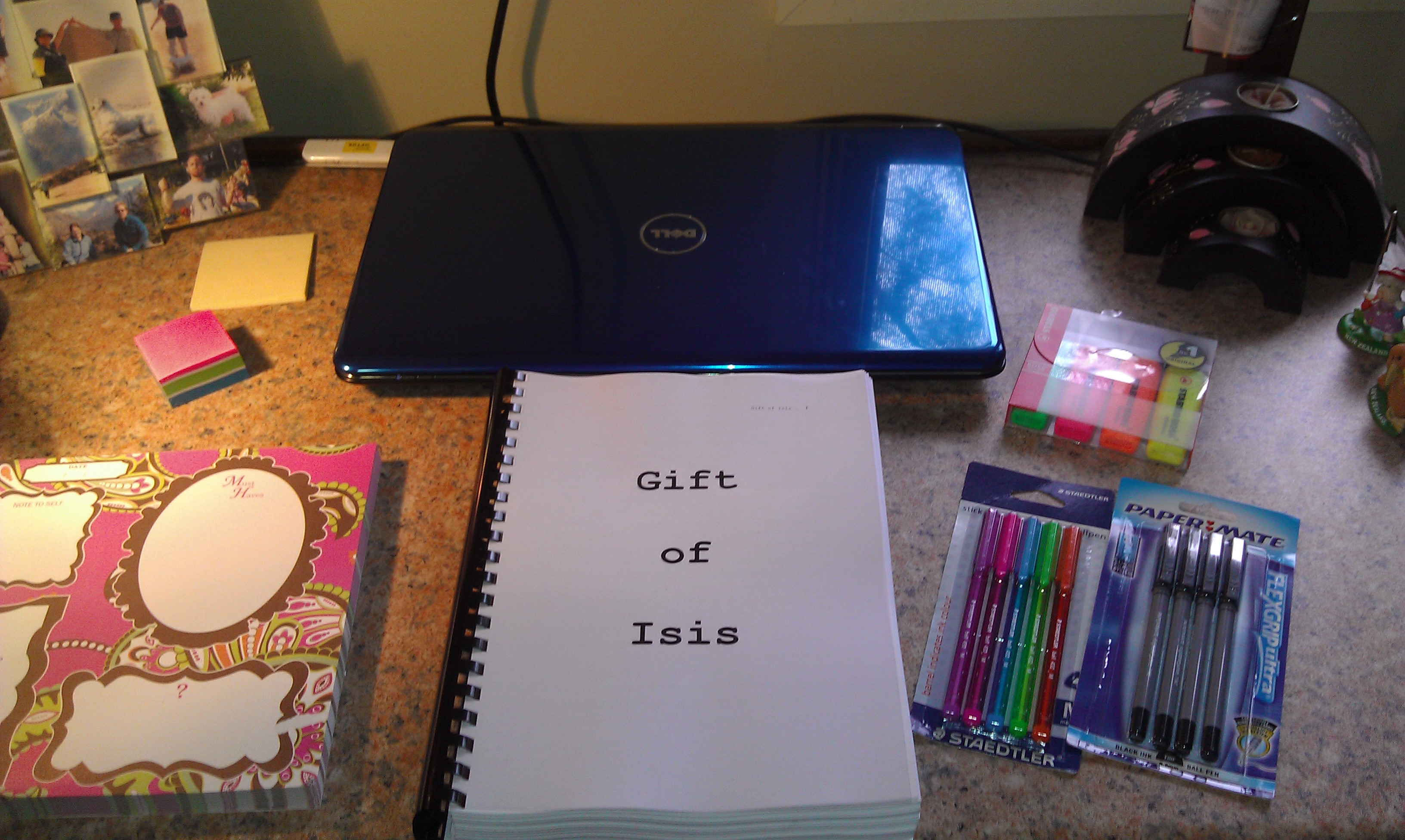
I started writing this post about eight weeks ago, at a time when finishing the first draft of MUSE seemed very far off indeed, and over the last few weeks, no matter which idea I try out, it’s that first one, the story I’ve already spent ten years on, that draws me to it. In fact, it seems my subconscious has decided for me because last weekend, without ever making a conscious decision to return to this project, I went to the copy shop and had the manuscript printed and bound, all 585 pages. It’s sitting on the desk in my study now, along with new packs of pens and highlighters. And it’s calling me. For better or worse, this is what I’ll be spending the next few months on. Only time will tell whether it’s a wise use of my time or just another round of edits on a project that will never sell.

How do you decide between projects?  Do you analyse the market and write what you think has the best chance of selling?  Or do you let your heart make the decision?


To Infodump, or Not to Infodump—that is the question

19 August 2011 | 3 Comments » | David Carrico

Actually, every writer with any experience at all will tell you that the question is not whether or not to infodump.  The answer to that question is automatically yes.  Yes, yes yes.  The need to provide mass quantities of data to the reader is almost universal.  Especially in longer works.  Most especially in longer works laid in milieus that are outside the reader’s common experience.

No, the real question—questions, rather—is how/when/where/how much to infodump?

And as much as I would like to be able to give the One True Answer to those questions, there is no such critter.

If you were to put three authors in a room and asked them one of those questions, you’d get probably get somewhere between five and nine opinions.

Actually, I misspoke.  There is one answer, but it is not an answer.  (And no, I’m not going all zen on you.)  The answer is . . .

It Depends.

Seriously.

That’s the only answer there can be.

Okay, setting aside the foolishness, here’s the hard core.

Yes, as a writer you have to be able to fill the void of ignorance each reader faces when he/she picks up a new work by you.  My experience is that writers attempt to do this in one of three ways.

1.      The Bulk Transfer Method

Wherein the writer attempts to stuff everything the reader might possibly need to know down the reader’s throat at once.  Two common forms of this are:

The dreaded “As you know, Bob…” conversation, in which one character will recount the history of the universe from the Big Bang all the way through to the ultimate death of heat, coincidentally along the way sprinkling the conversation with little nuggets of data that the reader might find useful somewhere around page 397.

The ubiquitous conference, wherein various talking heads sit around a table and explain to each other things that they already know but are needful for the reader’s understanding.

The problem is that, especially when attempted by new writers, these usually result in large indigestible blocks of verbiage sitting right athwart the plot line, and contact with said block all too often bounces the reader right out of his/her reader’s trance.  This is Not A Good Thing.

2.      The Teasing Method

Wherein the writer attempts to provide subtle hints—a word here, a phrase there—expecting the reader to not only read the written page but also the authorial mind, and somehow pull out of the aether the missing context needed to understand what the author is desiring to communicate.

The bad news here is that telepathy doesn’t work any better between authors and readers than it does between husbands and wives (which, based on personal experience, I’d have to say is not at all), and readers quit in frustration.

3.      The Pay As You Go Method

This is the one that most authors eventually develop, where they learn to tell the reader as much as the reader needs to know at that point in the story.  The trick is developing first the awareness of just what out of the entire back story and world building framework the reader needs at just that moment in the narrative; and second, the skill to add that to the narrative in the right spots and the right proportions.

The frustrating thing is that, like a lot of guidelines, we have all seen successful writers produce successful books that ignore them.  Well, just because they can get away with doesn’t mean we can.

Case in point:  two or three years ago I turned in a draft of a longish story to my editor.  Not long thereafter I got a note back:  “You have committed a staff meeting.”  Translation:  I had a ubiquitous conference in my story, and she didn’t like it.  “You know better than that.  Fix it, and I’ll buy the story.”  I attempted to justify what I had done by pointing to a recent novel by a well-known popular author that had a conference scene that ran for page after page after page.  Her response:  “You’re not him.  Fix it.”  I fixed it.

To summarize:  Option 2 just doesn’t work.  Option 1 doesn’t work well . . . except when it does.  Option 3 is preferred, except for those rare occasions when Option 1 is the best way to go.

In other words, It Depends.

Final word:  whatever technique is used to provide information, it can’t be just a static dump of data.  Somehow, in some way, the presentation of the data must advance the story.  If it doesn’t, we’re just building walls instead of roads to the end of the story.

Creating the Unpredicatably Predictable

17 August 2011 | 2 Comments » | Heidi

fantasy house hunting heidi2524 ATCAs a reader, I want new stories to enjoy, but I’m also looking for the types of stories that I enjoy.

This means I hit the fantasy and science fiction aisles of the bookstores, not the horror or literary fiction aisles. For the, ah, three decades that I’ve been reading these kinds of stories, a lot of the same themes, archetypes, plots, and settings have occurred. You name it, I’ve seen it – probably at least twice.

But I keep seeking out these kinds of stories.

Because each author has their own spin on farmboy-goes-to-big-city.

I like the predictability of what should happen, what I expect to happen, and the light vibration of something new that I feel from the first chapter that grows as I read a new book, letting the author lead me down a path that feels familiar but I know I’ve never traveled before.

As a writer, I tell the kinds of stories I like to read. It is my job to entertain the reader, to give them something the same but different, to fulfill their desire for new stories that are the same as the stories that they enjoy.

Some days it is easier than others.

A. C. Crispin had a recent ACCess blog post about “How to Satisfy Your Reader without Being Predictable” which I found to be a great read on this topic.

Then Brandon Sanderson talked about how one archetype his early novel Mythwalker worked (and eventually became his later novel Warbreaker) while another tried-and-true fantasy plot didn’t pan out in his “MYTHWALKER Prologue + Updates” blog post.

I think Brandon best surmised this balancing act of the same but different, being predictable and original, when he said …

Not every aspect of the story needs to be completely new. Blend the familiar and the strange—the new and the archetypal. Sometimes it’s best to rely on the work that has come before. Sometimes you need to cast it aside.

I guess one of the big tricks to becoming a published author is learning when to do which.


Black and White vs Grey Part 2: The Grey Camp

12 August 2011 | 2 Comments » | mary

In my last article I wrote about a particular audience of readers whom I called the “black and white team.”  These readers enjoy stories where clearly defined heroes and villains face off in battles of good vs. evil.  These stories can feature complex interplay between the heroes (and also between the villains), but in the end, there is never any question as to which side is “good”, and which is “bad”.  Facing off against the “black and white” team is the “grey camp,” who are looking for something different from their fiction.

I first encountered the “grey camp” as a group of people who’d watched a cartoon series and realized that they sympathized with the villains moreso than the heroes!  To their minds, the villains were strong, assertive, independent and persistent, whereas the heroes were passive, forever reacting to the villains instead of taking their own initiative, chastened by their leader if they went off on their own.  Small moments of dialogue and animation showed hints of affection between the villainous characters, indicating that the villains just might have a “life” outside of fighting the heroes.

This fandom’s “grey camp” hoped for more fiction that would develop the villains as rounded characters..  They argued that fans could care about the “bad guys” as much as they cared about the heroes. As it turns out, some of the ongoing fiction has begun presenting the villains as characters with conflicting beliefs, legitimate grievances, and admirable traits of their own.

These stories provide a challenge in that the protagonist must have enough positive traits for the reader to be interested in her and care about her actions, but she also must be “villainous” enough to be a credible member of the “enemy” side.  I think about “All Quiet on the Western Front,” a novel where the main character is a German soldier in the First World War.  Originally written in German, the translation into English allowed English readers to see the conflict “through enemy eyes.”  In other cases, the protagonists may do “bad” things, but the enemies they are fighting are worse, and therefore readers feel good about cheering for these anti-heroes.

Taken one step further, the “grey camp’s” stories can go beyond the good guy/bad guy dichotomy to show complex situations where two sides, both with positive and negative aspects, are set against one another.  Or, the hero might find herself with an ally who behaves in ways she finds disturbing or immoral.  These stories challenge the reader to see issues from different points of view.  They illustrate how upbringing, beliefs, personality traits, and life experience can affect a person’s interpretations.  Characters may experience the same event, but draw wholly different conclusions from the result.  Protagonists suffer from flaws and sometimes behave badly; antagonists show courage, loyalty, and friendship.  Characters, and readers, sometimes wonder which side is right, and why?

Writing the “grey camp” can be very challenging, and I will devote the next article to some of its pitfalls while providing suggestions and techniques.

Contested

10 August 2011 | 5 Comments » | Dylan Blacquiere

There comes a time, when the inspiration runs dry and nothing seems to be happening to get the words out on the page, when you realize that only a drastic measure will get things moving and keep you on the path of writing. Some people take the nuclear option and get rid of everything they’ve been writing, others shove it in a drawer for a while and move on to something else, hoping that inspiration will come back later and they’ll be able to start again with fresh eyes. I’ve found a new strategy that seems to be doing the trick; do something drastic. Like, say, write a whole novel in three days.

Not to shill for any one particular challenge, but the Three-Day Novel contest is a particularly fine example of the literary marathons that have been proliferating in the past several years. Most people are familiar with National Novel Writing Month, running since 1999 and in which participants commit to writing a novel of at least fifty-thousand words through the month of November. This contest is much less well known, but has actually been going on longer; it began in 1977 with a handful of people, and has now expanded to accept hundreds of entries a year. I did it before, two years ago; I produced a Very Literary Work that didn’t make the shortlist and in retrospect probably had very little to distinguish it from what I’m sure were a hundred other Very Literary Works, all earnestness and messages. This year, in a bit of a writing rut, I am trying again, and trying to write something truer to my voice, along my fantasy roots. We’ll see if it works. I will be holed up for the Labour Day weekend writing, and perhaps the next time I post I will have some update on how it went.

The reason I bring this up is that it seems like a perfect idea to strike a spark in the act of writing, some big ridiculous gesture that will have at its end a product that I hope will win the contest and be published. But in the end, such writing contests are about more than that. They are a way to impose a deadline , a defined end by which the act of writing has to be completed. I am the sort of person who has difficulty without a limit, as the lack of a certain amount of anxiety seems to keep me from doing what it is I set out to do. Many others will say the same, that the limit of as writing contest can be just what’s needed to kick-start a frustrating stall in the writing process.

I’d be interested to hear what others think about the use of writing contests as a way to get things moving. Is it a technique you’ve used in the past? Has it worked? In the meantime, I will post an update once the Labour Day Weekend has passed to let people know how it’s gone.

Throwing in the Towel

8 August 2011 | 3 Comments » | KDAlex

is often the most difficult decision that we have to make. Sometimes things just don’t work and you need to cut your losses and move on for greener pastures. Most of my posts thus far have been relatively positive pep-talks for you and me.

Unfortunately, sometimes there’s no positives that can come from something. And it hurts, bad. Like, real bad.

Here’s my problem. For the past seven months, I have been working on a draft of a steampunk “coming of age” story. It’s the most difficult thing I’ve ever worked on. Since November, I’ve accomplished a grand total of 49,000 words. Not even enough to claim a NaNo victory.

I think writing this story is probably the hardest thing that I’ve ever had to do. Harder than boot camp, harder than moving away from everyone and everything I’ve loved for a job that was everything but what I dreamed it would be. Harder than all the pain and suffering and defeat I’ve probably ever known.

It’s not that it’s the whole “writing a story” thing, when I’ve got the write idea (pun intended) and the characters are in my head, sometimes writing them is easy as eating or drinking. It’s not the concept, because the story details that I’ve worked out are an excellent concept.

It’s a poorly executed dream. And when I realized this, I started to learn how to let go.

See, my biggest issue was letting myself get too emotionally wrapped up into the story for reasons that I won’t even go into here, because there’s not enough Kleenex and let’s face it. You’re just not that bored to read about it.

I’ve been sitting on this post for about a month now because I wasn’t really sure how it would be received. I don’t even think I knew when I started writing this what the primary problem was. And forgive my rambling, but I’ve found that when I need to vent or clear the cobwebs out, the blog is here. Mostly, it’s advice to myself and the oft chance that someone else might find some pearls of wisdom amongst the dreck and drivel that I spout routine. =)

People shouldn’t get all wrapped up in books. I mean, after all they’re nothing more than words on a page (or screen) right? But try telling that to the librarian who selflessly devotes her time to share the joys of reading with the less fortunate children who wouldn’t blink an eye at a book either way. Tell that the authors who toil endlessly over their craft and creations. Writers write because they can. Readers read because they want to.

But, there’s something strangely mystical about the “book” itself, both the act of creation and the act of reading it. For some, they’re beach reads to kill an hour while they bake in the sun. For others, they’re the lost secrets and histories of the world whose keys can only be found by endless study.

If they’re just words on the page, meaningless and out of context, then try breaking the bad news to the collectors who search the inter tubes day in and day out to collect rarities, signed copies, first editions. you name it, they want it.

Me? I grew up in a house that didn’t read. My mom was too busy trying to raise me right and my dad was too busy to make sure the bills got paid. Books were the farthest thing from my parent’s mind. So, when I was an eager child of about six or seven, Disney just so happened to have the perfect answer to a child’s wonder.  They came in chapbooks and cheap hardbacks, serialized adventures of Donald Duck, Mickey Mouse, Goofy…hell, even Pluto got to star in his own adventures.

Every month I would make my parents take me with them to the grocery store. I didn’t whine for the Cocoa Puffs or the Lucky Charms. No, I wanted the Disney books. My parents couldn’t understand it, but they weren’t the ones to question a chance to expand their child’s growing mind.

Yet, they still couldn’t figure it out. Why was I so obsessed with books? Along came my aunt and uncle with the answer to that question.

And therein lies the issue of my discontent. I hated this book I was writing with a passion. I was obsessed with perfection. It wasn’t a book for me, it wasn’t a book for selling. No. It was a gift. To them.

It was supposed to be a thank you for making me some crazy bookworm.

And it failed miserably. Within my quest for perfection, I lost focus and the motivation for my story. Months came and went without me making my deadlines I couldn’t figure out what was wrong. The voice didn’t work, there’s issues with the plot.

You name it, I found the excuse for it. Ashes is my most written and rewritten work. In total, I’ve charted over 100,000 words that went absolutely nowhere. Throwing outlines out halfway through, tearing up whole chapters, rewriting scenes, points of view, everything, anything I could do to keep myself from finishing.

And then I realized the problem.

The book was too perfect that it was disgustingly imperfect. I could do no right with it. I needed to quit.

I felt terrible, crushed even. It was like watching the cat eat your goldfish, your favorite balloon loosening and flying away into the sky.

I gave up.

But, in my defeat I found success. Inside that crushing dread that motivated me to tear my hair out night after night, day after day, I discovered a gem in the muck.

I quit Ashes and finished Hills, rewrote Black, and started Psychic and Night Watch. These were projects that I put away, shelved and believed to be pure crap. After my crushing defeat, I found new life in these works and have worked tirelessly to whittle away the rough bark to leave my own pretty little race car.

And then I presented the absolute rough copy of Hills to my aunt and uncle, just a small token of thanks for their tireless dedication to me.

Soon enough, my other books will be finished with my friendly neighborhood editor. They will be presented in the same fashion, complete with jacket art and interior design. It was as close to published quality as I could get with being unpublished.

And the moral of my story: Find the strength in your weakness. The skies are always most beautiful after the storm.

Don’t be afraid to throw in the towel. When something doesn’t work, don’t sit and kill yourself over trying to turn guano to gold. If it’s meant to be, then it will be.

But, while you’re killing yourself trying to make things work, just think of all the other stories you have waiting to be told.

Sometimes they don’t like to wait. =)


Don’t forget the Bliss

5 August 2011 | 6 Comments » | Leigh Galbreath

It is said that everyone has a book in them. Not only is it ingrained in the human psyche to tell stories, but also for most of us, there’s something inside that just can’t stop telling a tale. It’s a passion that keeps us coming back, day after day, to the blank page — a hunger to fill the white spaces.

And like most of people with a passion, we dream of the day when that passion pays off and we can quit our mundane lives to devote all our time and effort into a job that we truly and absolutely love. Like the high school girl who heads off to Hollywood to become the next big movie star or the college kid who quits law school to become a rockstar, we who are called to the written word dream of being the next Bestseller. The only problem is that, unlike movie and rockstars, the bestselling author rarely gets the glamour or the big paycheck that sets them up for life.

We all know this, right? Writing will not make most of us rich.

And yet, we strive and shell out hard earned cash for workshops and seminars and books on craft so that we improve and can one day write that stunning masterpiece that will put us on the map. As we become more and more devoted to that dream, we put more time and effort into learning the business, pushing ourselves out of our solitary writerly existences to learn things like web design and marketing and promotion. All in the quest for becoming a published author. To be quite honest, I don’t so much feel that the “business” side of the writing business is outside my comfort zone as much as, when I do that stuff, I feel like someone is shoving bamboo rods under my fingernails.

I really hate doing that stuff. So much so, that I avoid it as much as possible. For I’ve come to realize that if I pay too much attention to that part of things, I start to forget why I liked writing in the first place. In hearing over and over how much work is demanded to  building a name before a publishing house will touch you, or singling yourself out from the e-mob on Amazon, it’s easy to get overwhelmed by all the stuff that has absolutely nothing to do with writing. It’s easy to forget the bliss.

In the end, it’s not fame and fortune that really drives us to write — that’s what record producers, TV networks, and movie studios are for. It’s not the ease of the work — writing is just plain hard most the time if you’re doing it right. It’s not the collaboration — even when working with other writers, most the time you’re still working alone.

It’s the passion. The bliss. It’s the drive that won’t let you think of doing anything else, because you just can’t kick the addiction to the written word.

So, strive, make your goals, work hard on that dream to become the next Big Thing in books. But don’t let the work make you forget why you dreamed the dream in the first place. Don’t ever forget the bliss.

So You Want to Start a Writer’s Group

3 August 2011 | Comments Off | Kevin Cioffi

The notion of the lonely writer, shrouded in solitary genius, is a myth easily debunked by nearly any writer making money today.  In reality, a writer treasures the feedback provided by editors and test audiences, and of course, the all important writer’s group.

While an editor can help professionally, writer’s groups are a great way to get feedback on a work in progress from similarly talented individuals, and naturally, a great place to meet friends with similar interests.  Trading favors, reviewing others’ work in exchange for some reviews of your own, is a great symbiotic relationship many writers could not live without.  The challenge, however, is finding a group that really works for you, and it is possible to make many missteps along the way.

Finding that perfect group is worth the challenge, but where to begin?  The first step is to find some candidates.  Fellow group members can be recruited from real life acquaintances, but if you do not know enough interested writers, you could always go online.  Sites like Craigslist can be used to find and setup a meeting between interested people in your area, or, if you are not successful there, you could also consider expanding your search and hosting a virtual writer’s group where writing and feedback are exchanged completely online.

Once the candidates are selected, the next important thing to consider is scheduling.  Each member of the group will invariably have their own conflicts that will have to be scheduled around, be they work or family commitments.  A day and time should be selected that works best for everyone in the group.  The next question is a matter of frequency: how often should you meet?  It is easy to start off overly ambitious, wanting to meet each week or even several times a week, but this could be a mistake.  Meet too often, and you risk burning out and making the group more of a burden on everyone than it needs to be, but this all depends on the determination of all the group members.  The rule of thumb here is that everyone needs enough time to read their assignments, be they sample chapters, shorter or longer excerpts, and develop commentary and feedback.  I would not recommend meeting more than once a week, and feel that meeting every other week has worked well for several of my writers’ groups in the past.  How long will each meeting last?  Keeping the group small, especially in the beginning, can help keep the meetings manageable.  Remember: you need enough time to address each person’s work, plus a little time to catch up and socialize as your group grows close.

Finding fellow members and a consistent schedule that works for everyone is the hard part.  What’s left is to iron out some of the nuances.  Where will your group meet?  Is someone willing to host the group in their home each time?  Perhaps a rotating set of homes?  If that is not especially convenient, you could always meet in a coffee shop, or a library if they have a conference type room available for use.  Will snacks or drinks be served?  Be careful on this point.  I belonged to a writer’s group that was essentially BYOB; everyone would bring a bottle of wine, a six pack, what have you, to enjoy during the discussions.  It really did sound like a good idea to us at the time, but it made us the complete opposite of productive.  By the end of the hours long meeting, we were all pretty tipsy and sloppy with our critiques.  Drink with extreme caution!

While it can be a lot of work to find interested members and a consistent schedule that works for everyone, once the group is up and running each member will have an irreplaceable addition to their repertoire: a source of free editing and feedback, and maybe even a new friend of two.

‘Tis But A Scratch!

1 August 2011 | 1 Comment » | Jason Michelsen

Cartoon Credit: Joe Sutliff, after Monty Python and the Holy Grail

As speculative fiction writers, we often find ourselves doing a lot of research. Much of that research goes into worldbuilding, pulling from this or that culture, borrowing this or that religious ritual. Every nation in my own world has roots in more than one ancient culture from our past, just enough familiarity to give the reader a solid frame of reference. And while everyone pretty much knows where to go to do that particular kind of research, I’ve come across a couple books recently that have helped me tremendously with the authenticity of other areas of my writing.

I write Epic/Heroic Fantasy of an adult nature.  It’s violent.  It’s bloody.  People get hurt, injured, maimed, disfigured, etc. Unfortunately – or fortunately, depending on how you look at it – I don’t get to observe people who have been injured on a daily basis. Aside from TV and pictures, I’ve only seen one dead body outside of a funeral home in my entire life, but I want my books to feel real. I want the injuries that occur to feel real, the consequences to feel real.

Recently, a friend of mine gave me a copy of Body Trauma: A Writer’s Guide to Wounds and Injuries by David W. Page, M.D. While the book does spend a good amount of time dealing with injuries caused by modern weapons, much of the information can be applied to ancient warfare. The chapter on abdominal trauma alone is worth the price of the book. I mean seriously, how many people will I run through with swords in my writing career? Probably one or two. There’s a chapter dealing with injuries to just about every body part with special chapters dealing with impalement, amputation, bug bites, frostbite and much much more. It’s a must have for any writer planning on hurting one of his characters.

Another book I’ve turned to on a number of occasions is Greek Fire, Poison Arrows, and Scorpion Bombs: Biological and Chemical Warfare in the Ancient World by Adrienne Mayor. I originally bought it as a research book for a huge siege set piece I have planned for a future book, but I’ve used it two other times to come up with devious methods of attack. It has information on everything from ancient flamethrowers to poison gases to incendiary bombs. Nothing pleasant, but all pleasantly helpful to anyone writing violent fiction.

And on a less “violent” note, I thought I’d bring up a book that some might never think to read if they’re interested in writing speculative fiction.  Robert McKee is a name widely known in Hollywood, but maybe not so much in the SFF community. He’s a screenwriter of some renown, and his book Story is one that anyone interested in telling stories should read. While it claims to be a book on screenwriting – and was indeed the required text for one of my classes in film school – it is so much more. McKee breaks storytelling down into the most basic elements, providing examples and showing how and why some elements work and others do not. I try to read Story at least once every 2-3 years. Not only is it educational, it is inspirational.

I hope these book recommendations prove helpful to someone out there. If anyone has any other books of this nature that they use regularly, feel free to post them in the comments section. I for one am always looking to expand my research library.