And the Winner is…

The adjudicators

Thank you to everyone who dropped by the Fictorians over the last week to enter our Jacqueline Carey giveaway.

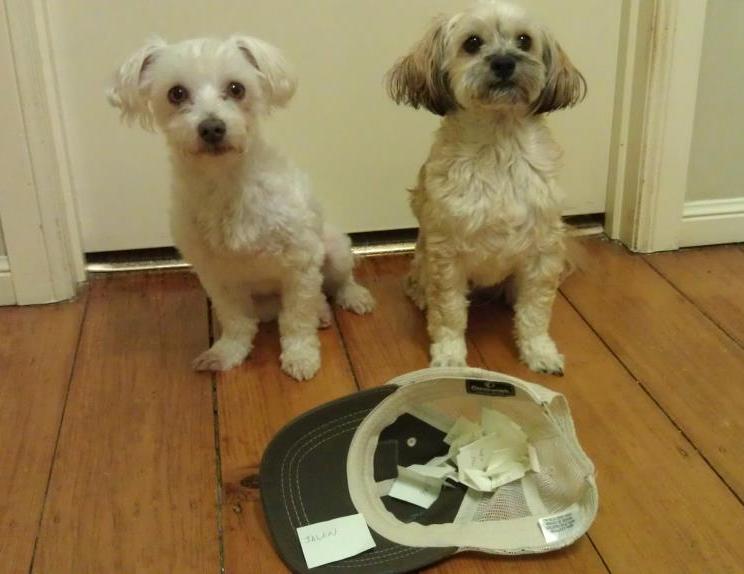
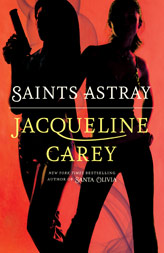
We have enjoyed reading about your favourite characters and I’ve added a few books to my “must buy” list. The lucky winner of a signed copy of Jacquelin’s latest book, Saints Astray, is… <drum roll> Jalen! Congratulations, Jalen. Send your mailing details to me at k.quillinan at yahoo dot com and I’ll pass them on to Jacquelin.

Thanks again to everyone who entered and a special thank you to Jacqueline Carey for making this contest possible.


Click here to read the first chapter of Saints Astray

Click here to order from Amazon.com

On the Fictorian Art

The truth is, writing fiction is hard.  No, correction, writing good fiction is hard.  This is borne out by the fact that the majority of new books in any given year are non-fiction.  The last statistics I remember seeing were that three out of every four new books published in the U.S. were non-fiction.  And if you removed elementary children books from the mix, the proportion would be even higher.

At first that seems counter-intuitive, doesn’t it?  I mean, when I look at a thick history of World War II, or a 500 page comparative theology book, or a multi-volume biography of someone like the Duke of Wellington, I am (reluctantly) impressed, and I think to myself that I could never do that.

Well, that may or may not be true.  But let’s look at this logically for a moment.

What is required to produce a work such as one of my three examples?

1.      The non-fiction author must do a lot of research and fact-gathering in order to lay the foundation for the book.

Does a fiction author have to do research?  If he’s any good, you betcha.  Why?  Because an author has to know the milieu/universe where his story is going to be laid, whether it’s historical, current, future, or fantasy in nature.  (See the posts about world-building.)

2.      The non-fiction author has to organize the researched material to support the thesis of the book.

Does a fiction author have to organize her material?  Yep.  She has to make sure that her story is consistent and has continuity.  Otherwise, people won’t enjoy it.

3.      The non-fiction author has to present the information well to make his case, and to tell the story he wants to tell.  (And yes, many non-fiction authors do tell stories.)

Does a fiction author have to tell . . .  Of course a fiction author has to tell a story!  That’s what writing fiction is all about, isn’t it?

So if the general skill set and methods appear to be so similar between the non-fiction author and the fiction author, what’s the difference between the two disciplines?  Getting back to the initial theme of this post, what makes writing fiction hard?  Or harder than writing non-fiction?

I would submit that it lies in the goal of the writer.

The non-fiction writer writes to impart information.  That’s pretty much it.  Oh, maybe she wants you to adopt a philosophical/political position based on her presentation, but it still comes down to imparting information.

The fiction writer writes to tell a story.  That’s the difference.  But more than that, the fiction writer writes to entertain, to enthrall, to enlist, to elicit, even to addict.  That requires something unique, something not ordinarily present in non-fiction:  the creative voice.

I’m sure there are people who will argue with me, but to me, the level of creativity required to write good fiction takes us out of the realm of craftsmanship and into the realm of art.  No matter how good our writing skills are, no matter how polished our authorial technique may be, if there is no creative voice in the story, it’s a flop.  And not everyone has the creative voice.

That’s not to say that skills and craftsmanship are not important.  They are.  After all, we really should know what the rules are before we can understand when it’s appropriate to bend or break them.  But there must be more than that in good fiction.  And it is the learning to apply the creative voice to the results of the research and the organizing of the material and the presentation of the material/case/story that makes fiction hard.

I’ve read a ridiculously large number of books in my life.  I can tell you with some assurance that I have never finished a non-fiction book, then turned back to page 1 and started over again.  I can, on the other hand, point to a number of fiction books where I have done exactly that.  I can even point you to one novel that I read cover to cover eight times in the first eight days I owned it.  Those authors’ creative voices entertained me, enticed me, drew me into their stories so profoundly that I didn’t want to let go.

That is the Fictorian Art.  And that is what we as Fictorians aspire to-are driven to, in most cases.

Welcome to the Fictorian world.
Burst Writing

This is not a new term, but the concept is new to me this year.  In a nutshell, it means writing as much as possible in a concentrated burst, like a sprinter in the 100-yard dash.  You can cover a lot of ground this way really fast.  It’s a lot like the November NaNo challenge, only even more intense.

It’s extremely productive, so why don’t I do it all the time?  Two reasons:

First, it requires setting aside a block of time in which to burst-write.  This is challenging in our hectic lives and limited vacation time.

Second, we need to be prepared.  You can’t sit down at your computer at the beginning of a burst sprint and ask yourself, “Now what should I write about?”  It would be like trying to sprint through a bamboo forest.  You won’t get very far.

A successful burst sprint is the culmination of a great deal of prep work.  Just like an Olympic sprint, which may only take a few seconds, can only be successful after months of preparation by the sprinters.

I have historically written more like a long-distance runner: slow and steady.  Depending on my work schedule, I might get to write once a week for a couple of hours, or not at all.  I’ve pushed myself to write daily, and for a few months this year I managed to do it.

I tried burst-writing this year for the first time.  I set aside a week in March and physically removed myself from all of the normal day-to-day distractions and just write.  For the first time, I’d developed a detailed outline of the story I wanted to write.  I had already written the first few chapters, soI felt like I had the character voices down pretty well, and I had a plan in place.

In one week, I wrote 52,000 words.  See my full blog post about the event here

Major success.  I completed about half of my novel.  I am currently working on the second draft of that same novel.  The burst was the culmination of several months of worldbuilding, brainstorming, planning, and outlining.

Lessons learned from the writing burst:

  1. Plan well.  I did have a pretty good outline, but I hadn’t addressed a few key concepts in the book, and I’ve had to go back in the second draft and revise.
  2. Don’t need an entire week.  Out of that week, I was most productive over a four-day period, averaging over 10,000 words per day.  It was hard to set aside an entire week, but it would be a lot easier to take a weekend and hide away somewhere for two or three days.  I could reasonably expect to complete at least 25,000 words in that timeframe.  That’s pretty good.  Outside of a burst-sprint, it can take weeks or even months to write that much, depending on my schedule.
  3. Don’t edit while writing.  To crank out that many words, you have to trust the plan and let your fingers fly.  Just write and keep pushing through the story.  This is where a weak outline will kill you because if you hit a snag or don’t know what happens next, you’ll totally lose your momentum.

One of the greatest benefits of burst-writing is seeing solid progress in a short period of time.  It’s exciting.  Sometimes the slow, plodding pace I’m forced into can be a little discouraging.  I start wondering if I’m ever going to finish.  Burst sprints help re-vitalize my enthusiasm and keeps me focused on the project.

I am gearing up for another burst-writing session, probably 3 or 4 days in length.  I was hoping to do it in November as part of the NaNo challenge, but the timing didn’t work out.  I’m still editing this story, and my outline of the next novel is only about 70% complete.  I’m hoping for a small burst sprint in December, with a longer one in January.

Until then, I look for one day a week where I can mini-burst:  at least 3 hours of dedicated, focused time.  Sometimes all I get is an hour, but longer periods are so much more productive because I can get in “the zone’ and stay there, cranking out the words.

For me, a two-hour minimum block of time is most productive.   What have other people found works best for them?  Have you tried burst-writing?  Has it worked for you?

The Invisible Library

I love collecting digital bits.

And I am considered an early adopter by friends.

As disorganized as I may be with files littering my virtual and actual desktops, I have an excellent track record of not losing digital data. Misplacing, yes, but my backup processes are fairly secure.

I hit the save key reflexively every few seconds or whenever I stop typing. I email copies of documents to myself to ensure they’re backed up in the cloud. I have onsite and offsite physical backups of all my files.

Ever since the advent of the Kindle and the iPad, I’ve been delighted. There are so many ways to access the rich library of documents I’ve been squirreling away for all these years. And with tools like Dropbox and various PDF viewers on the iPad, I’ve been able to have useful subsets of my digital library with me wherever I go.

Recently I’ve even begun backing up bits of my library. I’ve taken a number of big tomes and sent them to Blue Leaf Bookscanning to get turned into PDFs and word documents and even robot-read audiobooks.

But there’s a cost for me to digitization.

Serendipity.

In my home I have bookshelves. Many of them. And I have an area where I keep all my language books. And sometimes, when I walk over to that part of the shelf, I feel compelled to learn some more Portuguese verbs. Or another Latin phrase. It’s not planned.

I have another shelf full of mid 1800s American “Cyclopediae”. Had I planned to look up something in that? Not really. Was I enriched by it? Yes.

I have a shelf next to my bed, supposed to be a nightstand. It’s actually a two foot wide, 5 foot tall shelf. It has possibly 50 books I’m in the middle of browsing or reading. My “nightstand” gives me that same feeling I get when I stand in front of the magazine stand at a good bookstore. “Oooh – what am I going to choose?” There are too many good choices.

To be fair, I have experienced some form of this on my iPad. I’ve loaded up a ton of PDFs into the Apple iBooks app. Sadly (for Apple), I have to say that iBooks is only used store PDFs; Amazon has my eBook business and will keep it until I can read iBooks on my computer. (But that’s a separate rant.)

And so occasionally, I have said “why look there, there’s a book on programming Ruby on Rails, I should browse through that.”

“Oh theres that manual I downloaded on Intellectual Property and patent drafting, I’ll read it. ”

But the point is, I think it will be a while before I have the scant 64Gb of my iPad chock full of ALL my digital documents. Years in fact. I just don’t see it. First theres the scanning, or re-acquiring the book in digital form. Then there’s the filling the space, or hoping that “cloud books” comes out when “cloud music” is just getting started.

There’s no question that eBooks are rising fast. So much so that they will be the most significant part of the Western reading market soon. Ebook sales will be the driver, not just a growing segment, of book sales.

Books will go down fighting. It will probably take generations to fully marginalize books, even though digital formats are eclipsed within two decades. VHS. Tape. CDs. DVDs. Blu-Ray. These are all formats-come-lately. They have not persisted. Photographs and phonograph records are a bit longer lasting. But printed word has millennia of success.

So what of the browse? What of the bookstore? What of the random luck that comes from browsing not just a corner bookstore but of rediscovering one’s own library? Or of putting a reminder to one’s self to read a book, by leaving it in your bag?

When all books are equally accessible in a huge digital bookstore on your iPad, and when new books are constantly marketed to you, invading the privacy of your own tablet, what will this do to undirected reading? How will one continue to enjoy these essential and random encounters with books?

I don’t know. What I do know is that my family is shopping for a house right now. And after digging through probably a hundred houses on the multiple listing service, I remember just two have really stood out to me. I may make an offer on one next week. And only when I was finishing writing this article did I realize something.

Both of those homes have a library.