Have a Dream? Win a Book!

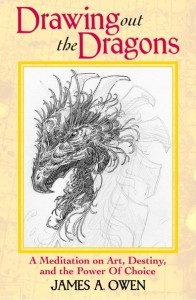
Want to win one of the LAST of the limited-edition hardcover copies of “Drawing out the Dragons,” personally signed by James A. Owen? Post on twitter (#JAOfreebook), fb, in our comments section, or anyplace on the internet about someone/something that inspires you, mention James and this fictorians post, and let us know about it in our comments section. For each mention, we’ll enter your name in the drawing. The winner will have their signed book shipped free of charge. We’ll run the contest until midnight, Thursday Oct. 18th, and announce the winner Friday morning, Oct. 19th. Play today, and tell a friend. James Owen’s book is for writers, artists, and anyone with a dream to achieve.  It even saves lives.

One of my greatest inspirations was my older brother. It may sound cliche, but the situation won’t. At the spurring of his wife, my brother earned a degree in accounting. He hated it, didn’t earn his CPA, and after a year teaching in a small high school in Northern Arizona, he divorced, started working construction to pay the bills, and remarried. As their kids grew older, his wife suggested it was time to pursue a job he liked. She worked extra hours so he could enter a training program, and he now works as a helicopter mechanic. In his forties, he made a complete career shift and he loves his job. It was his dream.

Sometimes, we think achieving our dreams means a big paycheck, a prestigious academic piece of paper, or celebrity status, but I don’t think that’s the point. Achieving our dreams is working our butts off so we can do what we love.  I like the part in Disney’s motion picture, “Tangled”,  where they sing about having a dream, especially the really big guy who wants to collect miniature unicorns. That seems simple and pointless to some, but the point is, there’s no dream too big or too small, every dream is individual, and we’re never too old to engage in its pursuit.Your dream is not mine, but we gather here at fictorians because we have similar dreams–we want to write. Our goals may be different in what we want to achieve with that writing, but the story drives us. I once expressed the great sense of belonging I feel at writing conventions. James Owen smiled at me and said with absolute understanding, “You’ve found your tribe.”

Yes, among you, my friends, I have found my tribe. Thank you. Now, go forth and fulfill your dreams for good, whatever they may be.

Lighten Up

Life is busy. We all have tons on our plates: family, day jobs, church, hobbies. Amid everything else, we aspiring writers struggle to squeeze in time to write.

Just about everyone I know is racing full speed ahead, myself included. Many of us fall into the trap of taking ourselves too seriously, and when life hits those ever-present road-bumps and fails to meet our expectations, we get stressed and cranky.  Not only does that make life unpleasant for us and anyone unfortunate enough to be around us at the time, tension and anger usually serves to block access to the creative side of the mind.  When trying to write, this kills productivity, which results in our becoming more stressed, and leads to a downward spiral that usually ends with any pages we’ve managed to write in that state having to be thrown away.

It’s time to lighten up.

Dr. Richard Carlson, in his best-selling book Don’t Sweat The Small Stuff, said, “People are frustrated and uptight about virtually everything – being five minutes late, having someone else show up five minutes late, being stuck in traffic, witnessing someone look at us wrong or say the wrong thing, paying bills, waiting in line, overcooking a meal, making an honest mistake – you name it, we all lose perspective over it.

The root of being uptight is our unwillingness to accept life as being different, in any way, from our expectations.”

I’ve been thinking about this a lot. Sure, life is busy and there’s a lot to do. As authors it’s far too easy to think about all the pages we haven’t written, or to curse the fickle muse who led us astray, resulting in yet another draft.

But that’s no fun.

I’ve decided to focus on the other side of the coin. When I get in ‘the zone’, focused on nothing but the story as words fill the page as fast as I can type, all those worries float away.  Those moments can be magical, and productivity soars.  So despite the fact that I’ve been writing for seven years with nothing yet published, I choose to focus instead on the skills and mastery of craft I’ve developed that I didn’t even know I needed to know when I started down this road. I now have three viable manuscripts in various stages of editing, with clear goals to work them to completion.  It’s been a long, difficult road to get this far, but it’s also been a wonder-filled journey I am deeply grateful I experienced.

Like Dr. Carlson says in his book, if we can learn flexibility and stop trying to control things we cannot control, we can evolve from battling life to dancing with it. Challenges will come, unforseen edits will be required, life will throw unexpected curves in our path. It’s going to happen anyway, and we already know we can’t control it. All we can control is our reaction.

I’ve decided to dance more and fight less.

What Does Your Dialogue Say About Your Characters?

Sometimes life has a way of sitting you down hard, making you take stock and reevaluating what you took for granted.  During one of these angsty periods, I found myself rethinking life goals and roles. Then came the hard part – articulating it. Somehow I had to find the words to define my feelings but I also needed the proper ones to express in a meaningful way what I was learning.

That got me thinking about dialogue in fiction and how we use it to convey information about characters like how they truly see the world.

The tendency is to make our protagonists the hero with a few issues who overcomes them and saves the day. As they are the point-of-view character, we learn a lot about how the character sees his world and reacts to it. With good writing, all the senses can be engaged. But, what about dialogue? Good dialogue is a window to a character’s soul. It is an opportunity to reveal, not tell.

‘Please, sir, I want some more.’

Who can ever forget that one famous line from Oliver Twist by Charles Dickens? Not only does it convey a little boy’s desperation, his starved state and his courage, it also informs us about the society in which he lives. The repetition of that simple phrase first by Oliver, then by Bumble who runs the workhouse and finally by Limbkins, Chairman of the Board of Guardians, firmly places Oliver’s words in our minds thus forcing us to live the horror of the statement from several points of view. This one simple piece of dialogue allows us to see and feel several aspects of a society.

This is followed by an equally simple phrase uttered and repeated: ‘That boy will be hung,’ said the gentleman in the white waistcoat. ‘I know that boy will be hung.’ There are no exclamation marks and no grandiose gestures, yet that simple statement followed by the simple speech tag said leaves us horrified.

There is a tendency to want to make characters appear smart and witty with that great comeback we would have liked to have when we ourselves were in an awkward situation. As writers, we must take care not to be helicopter parents, hovering over our characters, making them experience their lives the way we’d like to if we were them. Helicoptering can lead to sitcom dialogue – flat, witty characters without real depth – with purpose perhaps but not with depth.

Of all the books I’ve read and all the movies I’ve seen, my favorite dialogue, all 131 minutes of it, comes from the screen play of Edward Albee’s play, Who’s Afraid of Virginia Wolfe? starring Elizabeth Taylor and Richard Burton. The first time I saw it, I was a kid off the farm in first year university. I was appalled. For over two hours, these characters did nothing but fight. To me, it was simple, ordinary, and all too familiar. How could this movie be critically acclaimed?

Yet, it is the one movie which I remember vividly. That script keeps me spell bound. Using simple dialogue, Albee captures failed marriages perfectly. The characters are vile – definitely not sympathetic – yet I’m riveted to the script. The dialogue is not mannered, not witty – it is ordinary yet perfectly captured. It rolls quickly. It’s fast paced. The reveal, the show, are perfectly executed as demonstrated in this exchange between Martha and George:

M: (swinging around) Look, sweetheart, I can drink you under any goddamn table you want … so don’t worry about me!|
G: Martha, I gave you the prize years ago… There isn’t an abomination award going that you….
M: I swear …  if you existed I’d divorce you….
G: Well, just stay on your feet, that’s all… These people are your guests, you know, and…
M: I can’t even see you… I haven’t been able to see you for years….
G: …. if you pass out, or throw up or something…
M: …. I mean, you’re a blank, a cipher….
G: …. and try to keep your clothes on, too. There aren’t many more sickening sights than you with a couple of drinks in you and your skirt up over your head, you know…
M: …. a zero…
(Script excerpt from: C/file/view/Script+for+Who’s+afraid+of+Virginia+Woolf.pdf)

Take the time to understand not only what motivates your characters, but what their fears, their disappointments, their hopes and aspirations are for that will not only determine their actions and reactions, but it will give them unique and strong voices which will reveal more about them than any well written prose can tell.

Happy Writing!

In the Fight

I’m trained to never give up. There is no success in failure. I’ve been screamed at, stomped to the ground, kicked to the curb, and smoked sixteen dozen times until my arms wouldn’t bend and my legs wouldn’t move.

The only penalty for failure is death. And it’s not an option I’m willing to accept.

I’ve been shot at, damn near stabbed, been in more fights than I care to remember, and stared into the face of crazy itself. And  yet I still persevere and go into work every day because that’s just what you do.

Then how come it’s so easy for me to give up? To just say screw it. Maybe another day, another time? How come it’s so easy for me to just walk away, to cave into that one little voice in the back of my head that loooves nothing more than to sit there and be an absolute smart-ass?

How come a blank page is so scary?

I work the line between abject poverty and extreme wealth. Every day I see the haves and have nots…and the prices people are willing to pay and the blood they so willingly shed.

It’s a depressing existence, fluttering between two worlds and being party to none.

I come home to a loving family who is not loved by my family. Again, I flutter between two worlds. Positive and negative spinning in a perfect synchronized dance.

How do I find inspiration in a world so bleak?

Despite the rain, the clouds, the permeating darkness — flowers will still bloom. The sun will shine. And each day is a new day.

My inspiration comes from all around me: The beaming smile of a two year old happy to have her daddy home, the struggling people doing the best they can in the circumstances they’ve been birthed to and the victims of circumstance…the sheer excitement from opening a new pack of Magic cards or starting a new book. Will it be everything I hope it will? The lazy wings of a butterfly as it flits from tree to flower, sky to grass. The true colors of autumn in South Florida as the blue jays and cardinals come to wait out the winters up north…the listless, lazy crashing of waves on shore…I could go on and on.

It’s really, truly beautiful.

Every time I consider giving up, forgetting my writing, moving on with another life, a different hobby, another time, another place — I just think of the millions of other people out there every day, doing what they love, making the best of what they got.

It’s one of those things that just makes me wonder. If they can make it, then so can I. There’s much more agonizing ways to spend my time (root canal comes to mind) than sitting in an air conditioned room with my butt firmly planted on a nice, comfy chair.

So, even if I’m a year behind my deadline – I can do it. I know I can.

I’m trained to not give in to my fear. To never give up.

I will fight the fight.

I will not back down from the blinking black cursor and the blinding white screen.

Never give in. Never give up.